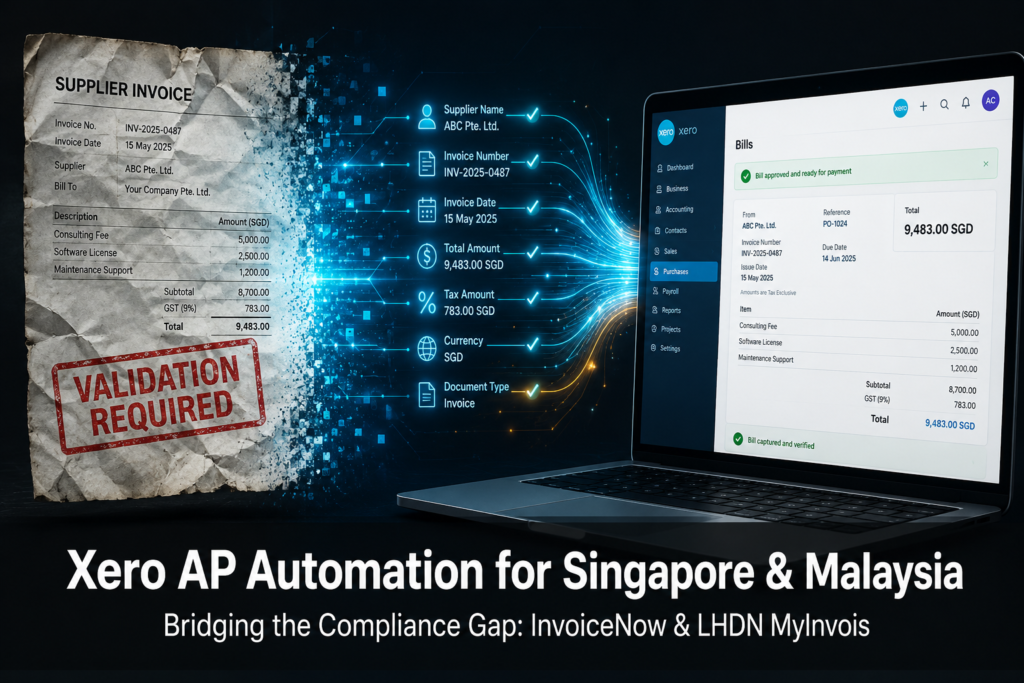






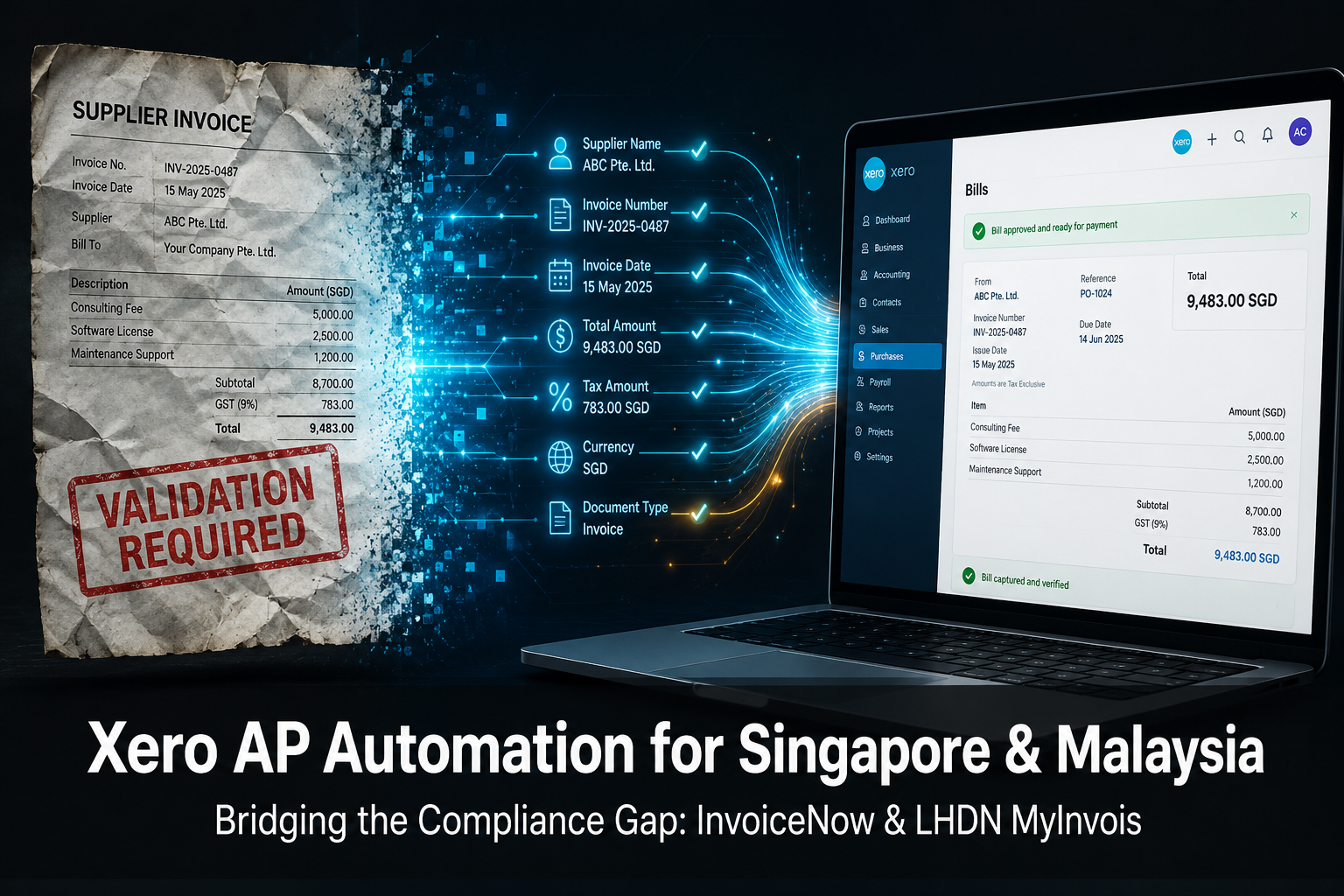

Xero AP automation simplifies accounts payable workflows by using AI and data extraction to capture supplier bills and sync transactions directly into your ledger. For growing businesses in Singapore and Malaysia, a dedicated accounts payable layer bridges your accounting software with critical statutory systems like the IMDA InvoiceNow network and Malaysia’s LHDN MyInvois framework. Discover how to transition from traditional processing to an automated, fully compliant system by reading our comprehensive breakdown below.
The Compliance Gap: Why Standard OCR Is Not Enough
Optical Character Recognition revolutionized accounting by eliminating manual data entry. You drop a PDF bill into your system, and the software extracts the vendor name, invoice date, total amount, and line items. In many global markets, this extracted data is sufficient to create a draft bill in Xero. However, operating within Singapore and Malaysia presents unique legislative hurdles that standard OCR cannot clear on its own.
The primary limitation of standard OCR is that it treats invoice ingestion as a flat data extraction exercise. It reads what is printed on the page, but it cannot verify if the invoice itself is legally valid according to local tax authorities. As both countries aggressively transition toward continuous transaction control frameworks, relying solely on OCR introduces considerable compliance risks.
In Singapore, the Infocomm Media Development Authority champions the InvoiceNow network.
InvoiceNow is a nationwide e-invoicing network based on the international Peppol standard that allows businesses to transmit structured digital invoices directly between financial systems, bypassing PDF processing entirely.
When a supplier sends an invoice over InvoiceNow, it arrives as a secure XML file containing pre-validated data. If your accounts payable workflow is built around scanning email attachments, you miss out on these secure network transactions. This gap is becoming more critical as tax authorities worldwide tighten their digital tracking. Understanding the shifting landscape outlined in the e-invoicing trends for 2025 shows that static document scanning is rapidly giving way to real-time network validation.
Across the causeway, Malaysia is executing a phased mandatory rollout of the Inland Revenue Board MyInvois framework. Under this regime, an invoice is not considered a legal document for tax deduction purposes until it has been validated in real-time by the LHDN platform. If your accounts payable process simply scans a supplier’s PDF and pushes it to Xero without checking for a valid LHDN Unique Identifier, your business risks claiming non-compliant expenses.
To maintain compliance and avoid audits, you need a system that looks beyond the text on the page to verify the underlying tax status of the transaction. For a complete breakdown of these requirements, review the complete guide to e-invoicing.
Native Accounting Hubs vs. Dedicated Accounts Payable Software
Xero provides a solid foundation for small and medium enterprises managing their books. Its native features handle standard bill tracking and simple expense claims smoothly. However, as business operations scale across borders or deal with high transaction volumes, the functional gap between Xero’s native capabilities and specialized accounts payable automation software becomes evident.
The table below contrasts how native cloud hubs handle AP workflows compared to a dedicated accounts payable layer tailored for Singapore and Malaysia.
| Operational Capability | Native Xero Hub Features | Dedicated AP Automation Software Layer |
| Data Extraction Depth | Basic header extraction with manual line-item splits. | Advanced line-item parsing with automatic tax code assignment. |
| 3-Way Matching | Manual comparison across purchase orders and bills. | Automated matching across POs, goods received notes, and invoices. |
| Local Tax Validation | Requires manual verification against external portals. | Native hooks into IMDA InvoiceNow and Malaysia’s LHDN api. |
| Multi-Currency Processing | Standard conversion at daily book rates. | Multi-currency invoice holding with localized tax split tracking. |
| Local Payment Rails | Manual preparation of bank CSV files. | Direct generation of localized batch files (GIRO, FAST, JomPAY). |
Relying entirely on a core ledger to manage complex, cross-border accounts payable tasks often leads to administrative bottlenecks. Finance teams find themselves jumping between external validation tools, banking portals, and the accounting system just to process a single batch of supplier bills.
Integrating specialized software with your core accounting platform allows your team to keep using a familiar ledger while introducing an automated gatekeeper for incoming bills. This approach ensures that data entering your ledger is pre-extracted, pre-matched, and cleared for local compliance. You can learn more about configuring this architecture by examining the setup for integration with xero.
Furthermore, operating across both Singapore and Malaysia adds foreign exchange variations and distinct local tax treatments to your daily workflows. A dedicated AP layer ensures that Singaporean GST and Malaysian SST or LHDN requirements are handled automatically before the transaction hits Xero. This specific cross-border capability is explored further in the documentation on e-invoicing Singapore Malaysia AssistBiz.
For companies running entities in multiple regions, consolidating these workflows avoids fragmented processes. Managing distinct regional demands within a unified AP framework reduces errors and keeps compliance simple, a topic discussed in depth in the guide on accounts payable invoice automation for US and APAC.
Implementing Multi-Way Matching and Local Bank Rails in Xero
To secure your supply chain and protect your working capital, your automated accounts payable process must move beyond simple invoice logging. Implementing strict multi-way matching ensures your business only pays for goods and services that were actually ordered and received.
Establish Automated Multi-Way Matching
When a supplier invoice arrives, your AP automation tool should automatically cross-reference it against your active purchase orders in Xero and your internal inventory or receiving logs.
- 2-Way Match: Checks the invoice bill against the original purchase order to ensure price and quantity consistency.
- 3-Way Match: Pulls in the goods received note or delivery order to confirm that items have arrived at your warehouse before approving payment.
Automating this verification safeguards your business against overcharging, duplicate billing, and vendor fraud. For step-by-step guidance on setting up these controls, read the 3-way match accounts payable the definitive guide to secure your supply chain.
Configure Localized Approval Workflows
Invoices that fail matching checks must be automatically routed to the correct department heads for review. Your approval chain should adapt based on the invoice value, department, or project code. High-value bills, for example, might require dual sign-offs from both a project manager and a financial controller. Building these rules directly into an automated workflow keeps approvals moving without drowning management in email threads. You can find strategies for structuring these rules in the overview of invoice approval workflow software.
Connect to Local Payment Infrastructure
Once an invoice is approved, the data should sync cleanly with Xero to prepare for payment. Instead of manually re-keying payment details into your banking terminal, your AP layer should consolidate approved bills into a localized batch file.
- In Singapore: Generate batch payment files compatible with FAST or GIRO rails.
- In Malaysia: Create files tailored for Interbank GIRO or JomPAY systems.
This secure data transfer eliminates entry mistakes, ensures vendors are paid on time, and simplifies your monthly bank reconciliations inside Xero.
Preparing for the Final Milestones of Malaysia’s LHDN Mandate
Malaysia’s transition to a nationwide electronic invoicing model is reaching its final, most comprehensive phases. While early waves focused on large enterprises, the mandate now covers small and medium enterprises across all sectors. Failing to adapt your accounts payable processes to this framework can disrupt your supply chain and create tax headaches.
According to Inland Revenue Board guidelines, the final phase mandates that all businesses, regardless of annual turnover, must issue and accept validated e-invoices. This change reshapes how accounts payable teams handle incoming bills.
When a supplier issues an invoice, they must submit it to the LHDN MyInvois portal for validation. Once approved, the invoice receives a distinct cryptographic UUID and an official QR code. When this bill lands in your AP inbox, your software must verify that UUID against the government portal before running standard internal matching checks.
Manually checking every supplier invoice against a government portal creates an unsustainable administrative burden for lean finance teams. Automated AP software handles this step in the background via direct API connections, checking the validity of incoming documents instantly. To get your business ready, check the roadmap outlined for the lhdn einvoice system malaysia.
Small businesses face distinct challenges during this transition, particularly when dealing with micro-vendors who may lack advanced digital billing tools. Managing these exceptions requires a clear operational framework, which is broken down in the e-invoicing Malaysia SME guide.
With the final deadlines approaching, reviewing your accounting architecture now will help you avoid last-minute issues and maintain clean books. Review the operational requirements detail in malaysia e-invoicing 2026.
Optimizing Your Financial Architecture for Scalable Growth
Upgrading your accounts payable process involves more than just swapping out paper for digital files; it requires a structural shift in how your finance team handles data. Transitioning from manual input to automated validation changes the role of your finance professionals from data entry clerks to data controllers. This shift allows your team to focus on capital management, cash flow analysis, and strategic sourcing.
As artificial intelligence becomes deeply integrated into standard accounting platforms, understanding its role can help you structure your workflows more effectively. For a broader look at how these technologies are changing the industry, read about how AI will impact accounting assist.
Building a modern financial setup requires connecting your core ledger with specialized tools designed for local compliance and efficient data processing. Selecting systems that handle cross-border tax compliance and automated validation helps future-proof your business against changing regulations. To understand this shifting landscape, explore the comprehensive insights in ai bookkeeping the definitive expert guide on automation compliance and the future of finance.
Developing a robust accounts payable framework helps businesses in Singapore and Malaysia remain agile, fully compliant, and ready to scale. Connecting your Xero ledger with Assist’s compliance automation infrastructure gives your team real-time visibility into liabilities while handling local tax requirements automatically. To find out how Assist can streamline your regional accounts payable workflows, reach out to an infrastructure specialist to evaluate your business’s AI readiness through the Assist registration portal.